The Essential Guide to Marine Lead-Acid Batteries: Durability & Corrosion Resistance
AUG.07,2025Lead-Acid Batteries for Golf Carts: Key Benefits & Trends
AUG.06,2025Energy Storage Solutions: Lead-Aide Batteries vs. Lithium-Ion
JUL.28,2025Understanding AGM Lead-Acid Batteries for Backup Power
JUL.28,2025Flooded Lead-Acid Batteries for Renewable Energy Storage
JUL.28,2025Gel Lead-Acid Batteries: A Long-Lasting Solution for Off-Grid Power
JUL.23,2025The Role of Lead-Acid Batteries in Electric Golf Carts
JUL.21,2025Telecom Power Systems: The Role of Lead-Acid Batteries
JUL.15,2025Lead-Acid Batteries in Power Tools: Dependability and Performance
JUL.15,2025Choosing Lead-Acid Batteries for Medical Equipment Backup
JUL.15,2025 Spaceflight Power Supply Co., Ltd.
Tel: +86-760-22555873
Fax: +86-760-22555873
E-mail: [email protected]
Add: 2108, Haigang City Office Building, No.1 Shengping East Road, Xiaolan Town, Zhongshan City, Guangdong Province
Lead-acid batteries, a staple in energy storage, have been pivotal in numerous applications ranging from automotive to industrial power backup systems. These batteries, while offering significant advantages such as reliability, cost-effectiveness, and widespread use, also present considerable sustainability challenges. The recycling of lead-acid batteries is crucial not only for reducing environmental harm but also for recovering valuable materials like lead and sulfuric acid. However, despite the well-established processes for recycling these batteries, numerous challenges remain in achieving efficient, safe, and environmentally-friendly recycling methods. This article delves into the current recycling processes of lead-acid batteries, highlights the sustainability challenges, and explores innovative solutions that could shape the future of this important industry.

Lead-acid batteries typically have a lifespan of 3 to 5 years, depending on factors such as usage patterns, maintenance, and environmental conditions. Once they reach the end of their useful life, these batteries need to be properly recycled to:
Despite the importance of recycling, the process involves numerous challenges that need to be addressed to ensure it is carried out in an environmentally responsible and economically feasible way.
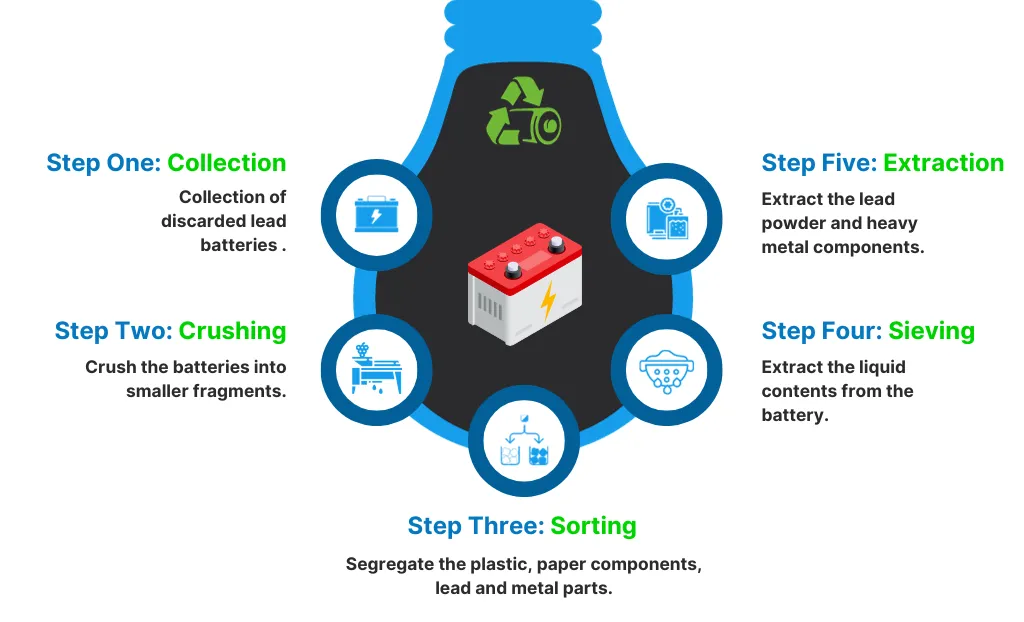
The recycling of lead-acid batteries generally involves a closed-loop process, wherein the components of the old batteries are reused in new ones. The main steps in the process include:
2.1. Collection and Transportation
Used lead-acid batteries are typically collected through collection points, such as automotive repair shops, recycling centers, or direct returns by consumers. These batteries are then transported to recycling facilities for processing.
2.2. Discharge and Separation
Before recycling, the batteries are discharged to remove any residual charge. Once discharged, the battery is disassembled into its various components, including lead plates, plastic casings, and sulfuric acid.
2.3. Lead Refining and Purification
Once the lead is melted down, it is refined to remove impurities. The purified lead is then cast into lead ingots, which can be used in the production of new lead-acid batteries or other lead-based products.
2.4. Reuse and Production
The recycled materials (lead, plastic, and sulfuric acid) are returned to the production cycle. The closed-loop process ensures that most of the materials from the old battery are reused, reducing the need for new raw materials and minimizing waste.
While the recycling process for lead-acid batteries has been in practice for decades and remains highly effective at recovering materials, there are still several significant sustainability challenges:
3.1. Environmental Pollution
Although the recycling of lead-acid batteries prevents many harmful materials from being released into the environment, improper recycling or disposal practices can still lead to environmental contamination. This includes:
3.2. Inefficiency in Some Recycling Methods
Not all lead-acid battery recycling processes are equally efficient. In some regions, outdated or substandard recycling techniques may be employed, leading to higher emissions, waste generation, and a lower recovery rate for lead and other materials.
Additionally, the collection and transportation of batteries can be resource-intensive, adding to the carbon footprint of the overall recycling process. Inefficiency in these areas exacerbates the environmental impact of lead-acid battery disposal.
3.3. Limited Recycling of Some Battery Components
While lead and plastic are effectively recycled, sulfuric acid recovery remains an area of concern. While some acid is neutralized and turned into byproducts, not all recycling facilities have the capacity to manage acid disposal safely, leading to potential environmental hazards. Also, the recycling of sulfuric acid is not as widespread as the recycling of lead, resulting in a significant portion of the acid being disposed of as waste.
3.4. Regulatory and Compliance Issues
There is significant variability in the regulations governing lead-acid battery recycling across different countries. In some regions, there are strict guidelines and standards, while others lack effective regulatory oversight, allowing informal or substandard practices to persist. For example:
Addressing the sustainability challenges of lead-acid battery recycling requires a multi-pronged approach, including improved technology, better regulation, and innovative practices.
4.1. Technological Advancements in Recycling
4.2. Strict Enforcement of Regulations
Tighter enforcement of environmental regulations and standards for battery recycling is critical. This includes monitoring facilities for proper waste disposal and ensuring compliance with safety guidelines to prevent contamination. Governments should also provide incentives for companies that use sustainable methods or invest in cleaner technologies.
4.3. Public Awareness and Industry Collaboration
Creating public awareness around the importance of responsible battery disposal can help reduce illegal dumping and encourage consumers to properly recycle their batteries. Additionally, industry collaboration between battery manufacturers, recyclers, and regulatory bodies can lead to the development of standardized best practices for recycling.
4.4. Investment in Alternative Materials
In the long term, the development of alternative materials for energy storage, such as lithium-ion and sodium-ion batteries, could reduce the demand for lead and other hazardous materials. While these alternatives are still in development, they could offer a more sustainable solution for the energy storage industry in the future.
The recycling of lead-acid batteries is an essential component of maintaining sustainability in the energy storage industry. While significant progress has been made in improving the efficiency and safety of recycling processes, several challenges remain, particularly related to environmental pollution, regulatory compliance, and recycling efficiency. Overcoming these challenges requires collaboration between industry stakeholders, innovation in recycling technologies, and stricter enforcement of environmental regulations. As the world moves toward more sustainable energy storage solutions, continued efforts to improve lead-acid battery recycling will be crucial in minimizing environmental impact and promoting resource conservation.
Spaceflight Power was founded in 1994 and named Zhongshan Spaceflight Power supply Co,. Ltd. In 2006, the company’s production base moved to Jiangxi Province for a larger production space with 120,000 square meters.
Learn About Spaceflight Power Learn About Spaceflight PowerCopyright © 2026 - Spaceflight Power Supply Co., Ltd. ALL RIGHTS RESERVED Shipping PolicyReturn PolicyPrivacy Policy